The results, though not yet judging comments on classes, are out from the 2010 Australian Alternative Varieties Wine Show held in Mildura last week. My main memory of Mildura from my last visit is a very large speeding fine copped while running late for a dinner at Stefano De Pieri's restaurant. I didn't make it to the show or the seminars and other events that coincide with it this year, but the results provide plenty to chew over about where Italian varieties, blends and styles are at in Australia.
This is the first year sagrantino and sagrantino blends had a class of their own. It is also the year pinot grigio/gris 'graduated' to mainstream status and out of the show. But that's another story.
The sagrantino inaugural class had nine entries, from a spread of regions. Five bronze and one silver medal were awarded across those nine wines, making for a pretty high hit-rate by my books. Five bronzes and two silvers were awarded across 26 presented wines in the 2009/2010 sangiovese class, by way of comparison.
The show would be better served if the results identified wines using actual wine regions, rather than place names many people will not know. That aside the sagrantino roll call, in scoring order (points the last number in each entry, out of 60) is:
Terra Felix (Port Melbourne), Terra Felix Sagrantino 2009, 52.5, Silver.
Oliver's Taranga Vineyards (McLaren Vale), Oliver's Taranga Sagrantino 2009, 49.5, Bronze.
Amadio Wines (Felixstow), Amadio Sagrantino 2009, 48.5, Bronze.
Chalmers Wines (Colbinabbin), Sagrantino 2009, 46.5, Bronze.
Coriole Vineyards (Mclaren Vale), Coriole Sagrantino 2007, 46.5, Bronze.
Preston Peak Wines (Preston), Sagrantino 2008, 46.5, Bronze.
Chalmers Wines (Colbinabbin), Sagrantino 2008 45.0.
Andrew Peace Wines (Piangil), Australia Felix Sagrantino 2007, 40.5.
Gracebrook Vineyards (King Valley), Sagrantino 2008, 40.0.
For the results, see www.aavws.com/media/file/PDFs/2010 Results.pdf
I'll have to go to the AAVWS next year. In the meantime, I'll pull together as many of these wines as I can and have a good look. I like the looks of how the list covers NSW, Victorian and South Australian regions, across a mix of climates.
Monday, November 8, 2010

Sunday, November 7, 2010
Moscato and globe artichokes
A small experiment last night at a dinner. The globe artichoke crop here is large, so I picked 14 and after soaking to evict the earwigs, boiled them up to serve with melted butter, salt and balsamic vinegar dipping. There was a bottle of Kay Brothers 2010 moscato unopened from the dumpling dinner Friday evening, so this was the match-up.
Globe artichokes, particularly if you eat quite a lot and they aren't denatured by preserving, have an interesting impact on sweetness perception. The further you go with eating them, the effect of making subsequent food or liquid seem sweeter heightens. But what about with sweet wine, like moscato?
The effect on sweetness was as expected, but could be partly counteracted by vinegar if used in dipping of leaf bases. But there was also an impact on perceptions of bitterness and astringency which I had not expected. The moscato became sweeter following the artichoke, but an astringency also appeared when tasting the wine that had not been there when having it beforehand. Not something I have a particular explanation for, but a fascinating experiment.
And I still have around 40 artichokes still to pick of the first flush. The dry-land Mediterranean landscaping of the front yard is loving this wet year.
Globe artichokes, particularly if you eat quite a lot and they aren't denatured by preserving, have an interesting impact on sweetness perception. The further you go with eating them, the effect of making subsequent food or liquid seem sweeter heightens. But what about with sweet wine, like moscato?
The effect on sweetness was as expected, but could be partly counteracted by vinegar if used in dipping of leaf bases. But there was also an impact on perceptions of bitterness and astringency which I had not expected. The moscato became sweeter following the artichoke, but an astringency also appeared when tasting the wine that had not been there when having it beforehand. Not something I have a particular explanation for, but a fascinating experiment.
And I still have around 40 artichokes still to pick of the first flush. The dry-land Mediterranean landscaping of the front yard is loving this wet year.
Thursday, November 4, 2010
Wet Spring in the vineyard
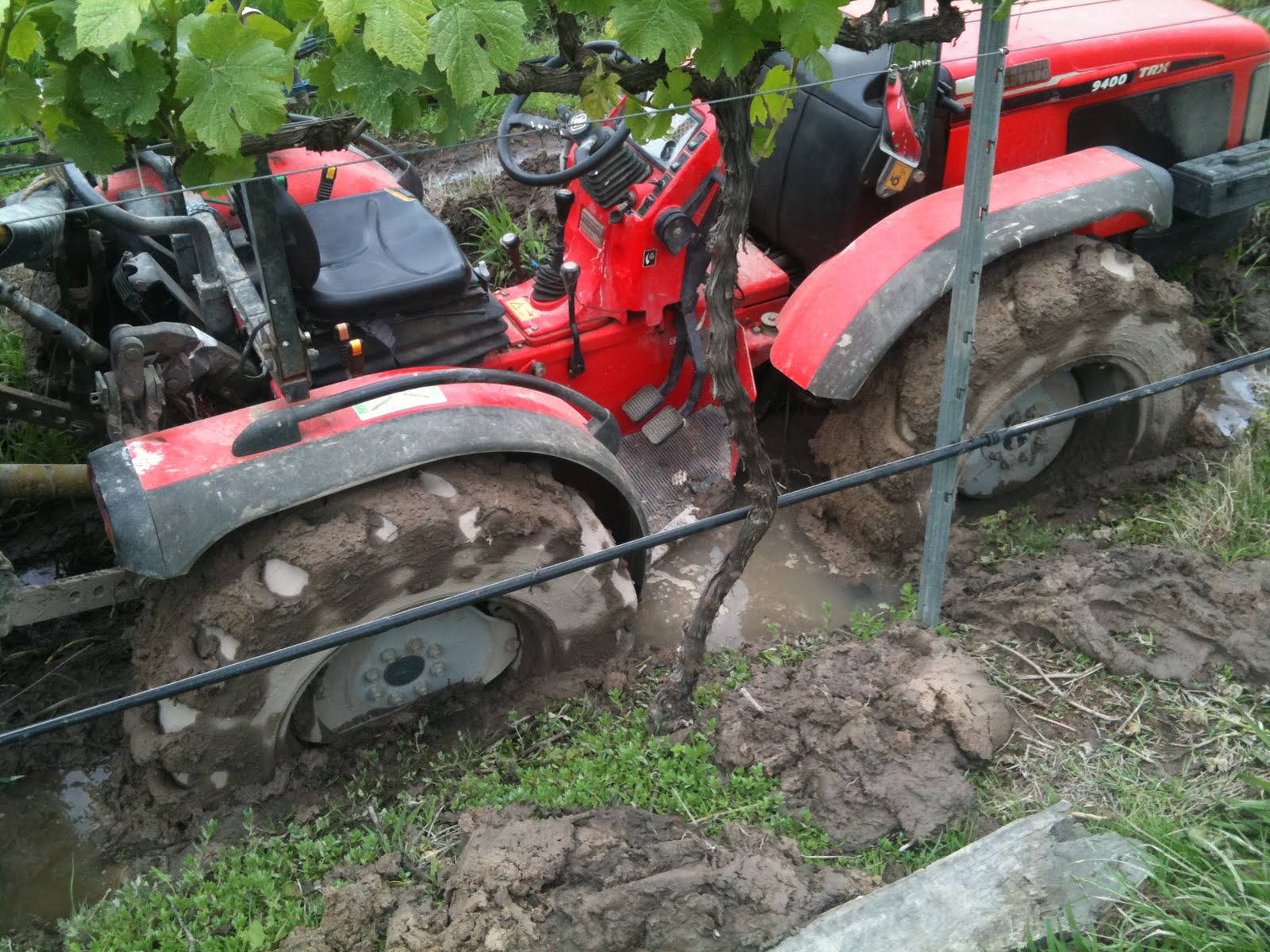
Aside from risks of mildew and soggy boots, a wet start to the vineyard year in Spring can make it tricky for the tractor.
Wednesday, November 3, 2010
Viticoltori Ponte Prosecco Extra Dry NV
Prosecco, like cava, is the kind of sparkling white wine I most enjoy for casual drinking, or having with food. As good as Champagne is for peak wine experiences, I'd have to admit I've had more pleasure, more often, from cava and prosecco.
Last night, visiting Sydney for work, I ducked in to the Canteen space at Sailors Thai up in the Rocks. A salad of grilled squid with green mango, and a stir-fry of ground pork and green beans were food highlights. But the compatibility of the Ponte Prosecco with food was startling.
Viticoltori Ponte produces several sparkling wines, including this 100% prosecco (glera) from vineyards in Treviso (Piave DOC). The acid is brisk, but not grating. The fruit moved between red-skinned apple, lemon and Granny Smith. In spite of the 'Extra Dry' designation there was enough generosity (even sweetness) to balance the hot/salty/sour/sweet of the dishes. Green mango and prosecco... a new one for me, but it worked, including for a second glass.
Last night, visiting Sydney for work, I ducked in to the Canteen space at Sailors Thai up in the Rocks. A salad of grilled squid with green mango, and a stir-fry of ground pork and green beans were food highlights. But the compatibility of the Ponte Prosecco with food was startling.
Viticoltori Ponte produces several sparkling wines, including this 100% prosecco (glera) from vineyards in Treviso (Piave DOC). The acid is brisk, but not grating. The fruit moved between red-skinned apple, lemon and Granny Smith. In spite of the 'Extra Dry' designation there was enough generosity (even sweetness) to balance the hot/salty/sour/sweet of the dishes. Green mango and prosecco... a new one for me, but it worked, including for a second glass.
Monday, November 1, 2010
Taminick Cellars 1919 Series Trebbiano 2010 (Glenrowan)

Trebbiano is a name common to a group of different, if related, vines, usually sharing a common feature of acid blandness. Often dismissed as a wine-lake grape for jug wines and vermouth makers (ugni blanc is a trebbiano), it can make for honest, even surprising wines.
Booth's at Glenrowan have trebbiano plantings dating from 1919 and currently make three trebbiano-based wines. This wine, retailing for $14 a bottle, is the dry, racy, table wine, sold in a riesling bottle (an accurate signal). There is also a sweet trebbiano and a fortified 'gold' trebbiano made in the mode of a white port.
The 2010 1919 series trebbiano from Taminick Cellars is tight, dry, has racy lemon acid and a bit of length about it. But the best feature is the slightest curve of waxy texture and flavour through the mid-palate. I'm no expert with trebbiano, but the good ones I have had show that waxy hint at richness as the acid races along. While some trebbiano can age with interest (especially when made into vin santo), the vast majority are for quick drinking. This is one of those: grab and enjoy it young, fresh and sharp, perhaps with salt and pepper squid, chicken in a tarragon and cream sauce, or octopus marinated in olive oil. 12.5% alcohol.
The image is of quince blossom.
Monday, October 25, 2010
Beechworth, King Valley, Glenrowan: 3 parts Italian

Got back last night from a weekend in Northern Victoria. The major drawcard was the first open day at Castagna in Beechworth. I consider the Castagna La Chiave straight sangiovese and the Un Segreto 'super-Beechworth' syrah-sangiovese blend some of the top Italian wines in Australia and have been purchasing Castagna wines for several years.
But the trip also meant I could look at the Italian wines of Chrismont at their new cellar door in the King Valley, and then cross the Hume Highway to look at the 1919 vines trebbiano from Booths Taminick Cellars at Glenrowan.
Highlights for me:
- the 2004 La Chiave sangiovese from Castagna has developed beautifully with years of growth still to come, though the Genesis syrah and Sparkling Genesis were the standout Castagna wines
- the Chrismont prosecco had all the dangerous drinkability of good cava, but their Barbera was the most impressive Italian in the range
- at $14 a bottle, sourced from trebbiano vines planted in 1919, with some attractive fruit and flesh on the midpalate, the 1919 Taminick Cellars trebbiano seriously over-delivers.
Each visit deserves a separate write-up, but the two days as a whole confirmed the prospects of three northern Victorian regions to make distinctive and interesting wines from Italian grape varieties.
The image, taken by Tammy, is of the 2008 Genesis syrah, looking out to the Castagna vineyard.
Friday, October 22, 2010
Tenuta Cocci Grifoni, Colle Vecchio, Pecorino 2007 (Le Marche)
Just how many grape varieties are there in Italy? More than 350 varieties have authorised status, and estimates range widely as to how many hundreds (even thousands) there may be in total.
This wine, from the Marches (that coastal and hilly region of the centre, adjoining Umbria and Tuscany), is the first wine I have had from the pecorino grape. Pecorino, grown in Le Marche and a handful of other Italian regions, was a grape 're-discovered' by Guido Cocci Grifoni in the 1980s. An early ripening white grape, pecorino can develop rich flavours, textures and potential alcohol. Low productivity had caused its decline until the recent revival of interest.
This bottle started out showing cheesy characters, with passionfruit and pear carrying through the nose and into the palate. Nice, lingering phenolics, even a bit of tannin, takes you out (along with some oldish, slightly oxidised, citrus notes). Interesting wine, and could go well with antipasti such as grilled marinated vegetables or a seafood salad.
http://www.tenutacoccigrifoni.it/
This wine, from the Marches (that coastal and hilly region of the centre, adjoining Umbria and Tuscany), is the first wine I have had from the pecorino grape. Pecorino, grown in Le Marche and a handful of other Italian regions, was a grape 're-discovered' by Guido Cocci Grifoni in the 1980s. An early ripening white grape, pecorino can develop rich flavours, textures and potential alcohol. Low productivity had caused its decline until the recent revival of interest.
This bottle started out showing cheesy characters, with passionfruit and pear carrying through the nose and into the palate. Nice, lingering phenolics, even a bit of tannin, takes you out (along with some oldish, slightly oxidised, citrus notes). Interesting wine, and could go well with antipasti such as grilled marinated vegetables or a seafood salad.
http://www.tenutacoccigrifoni.it/
Subscribe to:
Posts (Atom)