One of the best examples of Dolcetto I have tried - as much a Sandrone wine as the 'little, sweet one' of the variety. More interest, length, texture and layered flavour than a lot of basic Nebbiolo. Give it a decant. Try with a pork sausage pasta dish or pizza with cured meats. Fine value too.
Showing posts with label 2011. Show all posts
Saturday, February 15, 2014
Luciano Sandrone Dolcetto d'Alba 2011 (Piedmont)
Serious Dolcetto here. A silky line, fuzzed up by well-extracted fruit tannin. Lots of length. As with the Sandrone Nebbiolo d'Alba, there is a beautiful lift of mouth-perfume here, on top of the floral and gently musky smells in the glass. Again akin to the Nebbiolo, there is a mixture of cherry and cherry stone characters in the wine, with no oak influence.
One of the best examples of Dolcetto I have tried - as much a Sandrone wine as the 'little, sweet one' of the variety. More interest, length, texture and layered flavour than a lot of basic Nebbiolo. Give it a decant. Try with a pork sausage pasta dish or pizza with cured meats. Fine value too.
$35, purchase, cork, 13%, imported by Bibendum, website here.
One of the best examples of Dolcetto I have tried - as much a Sandrone wine as the 'little, sweet one' of the variety. More interest, length, texture and layered flavour than a lot of basic Nebbiolo. Give it a decant. Try with a pork sausage pasta dish or pizza with cured meats. Fine value too.
Labels:
2011,
Dolcetto,
Dolcetto d'Alba,
Italy,
Luciano Sandrone,
Piedmont
Tuesday, November 12, 2013
Feudo Zirtari Inzolia Chardonnay 2011 (Sicily)
Lemon juice and curd, a bit of dry herb, a salty, briny lick of flavour, this attractively-priced Sicilian white blend of Inzolia and Chardonnay is a Costco offering. Not a wide, mouth-filling shape of Sicilian white, but there is solid flavour here, especially in the mid-palate. Length, not so much, but with a plate of sardines I think this might take some beating as a $10 white.
Gift, $10, screwcap, 13% alcohol.
Labels:
2011,
Chardonnay,
Costco,
Feudo Zirtari,
Inzolia,
Italian whites,
Italy,
Sicily
Friday, November 1, 2013
Fattori Roncha 2011 (Veneto)
Continuing my run of northern Italian whites.
Fattori is a family-owned and run producer, operating since the 1970s out of the Veneto. Their white wines come from a mixture of varieties grown on the basalt slopes of the Alpone valley, including the hills of Roncà.
This 'Roncha' white blend starts with 50% Garganega, including 5% of partially-dried grapes. Pinot grigio (picked a little early) and Trebbiano di Soave are 20% each in the blend. The final 10% component comes from the late-ripening, high-acid Durella variety.
The fruit sees a mix of stainless steel and barrels, but the complexity, the sense of 'work' in the wine is quite subtle. The most distinctive feature here is a clean and clear hit of mandarin flavour and mandarin acid. Perhaps this is the Durella influence, but regardless, this is the most mandarin-y wine I can recall having. Tasty, bright and fresh, yet not lacking fruit weight, this was a good fit with a Cantonese meal and I think even better with dishes containing fresh or dried citrus.
$28-$35, cork, purchase, 13% alcohol, website here, imported by Deja Vu Wine Company.
Fattori is a family-owned and run producer, operating since the 1970s out of the Veneto. Their white wines come from a mixture of varieties grown on the basalt slopes of the Alpone valley, including the hills of Roncà.
This 'Roncha' white blend starts with 50% Garganega, including 5% of partially-dried grapes. Pinot grigio (picked a little early) and Trebbiano di Soave are 20% each in the blend. The final 10% component comes from the late-ripening, high-acid Durella variety.
The fruit sees a mix of stainless steel and barrels, but the complexity, the sense of 'work' in the wine is quite subtle. The most distinctive feature here is a clean and clear hit of mandarin flavour and mandarin acid. Perhaps this is the Durella influence, but regardless, this is the most mandarin-y wine I can recall having. Tasty, bright and fresh, yet not lacking fruit weight, this was a good fit with a Cantonese meal and I think even better with dishes containing fresh or dried citrus.
$28-$35, cork, purchase, 13% alcohol, website here, imported by Deja Vu Wine Company.
Labels:
2011,
Durella,
Fattori,
Garganega,
Italian whites,
Italy,
pinot grigio,
Trebbiano,
Veneto,
White wine
Sunday, September 22, 2013
Rocca de Montegrossi 2011 Chianti Classico (Tuscany)
Big, rich, wild & juicy, this is still characterised by the sour cherry, acid cut and drying tannin of Sangiovese. There is 5% Colorino to lift the colour and weight of fruit. The mulberry and wild bramble characters seem those of the 5% Canaiolo, unless a bit of something merlot-like slid into the vat. The tannin and acid say Tuscany, but the fruit looks more Australian - a good mix. Drink this young, while the fruit has sway.
Tasted over two nights: first with smoked lamb & cous cous; second with penne, bacon & mushrooms. The fruit more expansive, the tannins more assertive the second night, but both times good drinking.
Cork, 13.5% alcohol, brought in by Trembath & Taylor, $36, purchase, website here.
Tasted over two nights: first with smoked lamb & cous cous; second with penne, bacon & mushrooms. The fruit more expansive, the tannins more assertive the second night, but both times good drinking.
Cork, 13.5% alcohol, brought in by Trembath & Taylor, $36, purchase, website here.
Labels:
2011,
Canaiolo,
Chianti,
Colorino,
Italy,
Rocca de Montegrossi,
sangiovese,
Trembath and Taylor,
Tuscany
Friday, September 20, 2013
Pieropan La Rocca Soave 2011 (Veneto)
Earlier this week, I made it along to a tasting of a dozen Mencia wines from Spain. I have a lot of time for the Mencia grape and was keen to see wines from Bierzo, Ribeira Sacra and parts nearby in a group. The first thing to say is the wines were tasted without food and the second that quite a few of the wines were talked down by tasters for being 'short' and having 'short fruit'. I was puzzled for a while at hearing this about wines where I thought there was some length. It took me a while to realise I was content to see tannin, acid and non-fruit flavours carrying the wine out, with the fruit bunching up in the front and middle of the wine. But for other tasters, this was not length. Length was fruit, fruit the way along. So only a small number of the Mencia wines appealed to them, those with length of fruit.
So why a note on a Soave starting off in the north of Spain?
This Soave Classico from Pieropan is a good showing of what the Garganega grape can do. It is a single vineyard bottling, from a vineyard on the side of the Monte Rocchetta hill. Pieropan are old hands and sure; first making a Soave under this label in 1978.
A combination of sweet, floral and gently nutty smells here that I think of as like good nougat. Tasting the wine, there is an overt pear character, a bit of apple tucked away underneath and some bright lemony acid stitching things together. The fruit is generous, nothing stinting, but leaves room enough for a finish that is all about mineral, acid and some subtle grip. A classic example of a wine with a lot of length that uses more than fruit to get there. Judging this for length of fruit alone would miss the point. Much as with some of those Mencia wines, for my tastes.
Going strong on a second night open, this could be enjoyed by itself or with a fish or chicken dish using some grain and lemon. Fish tagine with pickled lemon and cous cous, maybe. I had it out at Pulp Kitchen with an excellent chicken liver dish, so lighter terrines and pates would be good too. A fine reminder for me of how much interest and versatility there can be in the best of Soave.
Cork, $37, purchase, brought in by Trembath & Taylor, 13% alcohol, website here.
So why a note on a Soave starting off in the north of Spain?
This Soave Classico from Pieropan is a good showing of what the Garganega grape can do. It is a single vineyard bottling, from a vineyard on the side of the Monte Rocchetta hill. Pieropan are old hands and sure; first making a Soave under this label in 1978.
A combination of sweet, floral and gently nutty smells here that I think of as like good nougat. Tasting the wine, there is an overt pear character, a bit of apple tucked away underneath and some bright lemony acid stitching things together. The fruit is generous, nothing stinting, but leaves room enough for a finish that is all about mineral, acid and some subtle grip. A classic example of a wine with a lot of length that uses more than fruit to get there. Judging this for length of fruit alone would miss the point. Much as with some of those Mencia wines, for my tastes.
Going strong on a second night open, this could be enjoyed by itself or with a fish or chicken dish using some grain and lemon. Fish tagine with pickled lemon and cous cous, maybe. I had it out at Pulp Kitchen with an excellent chicken liver dish, so lighter terrines and pates would be good too. A fine reminder for me of how much interest and versatility there can be in the best of Soave.
Cork, $37, purchase, brought in by Trembath & Taylor, 13% alcohol, website here.
Labels:
2011,
Garganega,
Italian whites,
Italy,
Pieropan,
Soave. Veneto,
Trembath and Taylor
Tuesday, February 5, 2013
Occhipinti SP68 Rosso 2011 (Sicily)
A night out at Italian & Sons. A call for a red, something light, to go with the food. A section of the list as 'Pinot Nero & Others'. A blend from 2011 of Nero d'Avola and Frappato. Sicily. Occhipinti rings a bell. An asterisk to a footnote of organic, biodynamic or natural wine. Let's go then.
Beef carpaccio, garnished with fried capers. A beautiful dish, both with a 'wrong' negroni and then the first of the Occhipinti. Then a wet braise of lamb in the wood-fired oven, with peas, potato and globe artichoke. Pizza funghi on the table too. The wine so brightly red-fruited, so clean and clear. Raspberry and red currant from the nero. Sour strawberry from the frappato. So well stitched together. You don't even think about tannin, or analysis. You do think about a second bottle.
Hook in.
Cork. Purchase. Retails about $40 a bottle, more on a list. Brought in by Addley Clark. Occhipinti website here.
Beef carpaccio, garnished with fried capers. A beautiful dish, both with a 'wrong' negroni and then the first of the Occhipinti. Then a wet braise of lamb in the wood-fired oven, with peas, potato and globe artichoke. Pizza funghi on the table too. The wine so brightly red-fruited, so clean and clear. Raspberry and red currant from the nero. Sour strawberry from the frappato. So well stitched together. You don't even think about tannin, or analysis. You do think about a second bottle.
Hook in.
Cork. Purchase. Retails about $40 a bottle, more on a list. Brought in by Addley Clark. Occhipinti website here.
Labels:
2011,
Frappato,
Italian wine,
Nero d'Avola,
Occhipinti,
Sicily
Sunday, February 3, 2013
Montevecchio Rosso 2011 (Heathcote)
Montevecchio is a new brand from the Chalmers family - one of the driving forces behind alternative varieties in Australia, both with their Chalmers Wines brand, their previous vineyard and nursery, and their support for the Australian Alternative Varieties Wine Show.
The Chalmers sold their original vineyard (from where I bought sagrantino fruit in 2007) to Macquarie. While much of the nursery stocks of rare clones, including the MAT clones imported from Italy, has since been bulldozed, the family also set up a Heathcote vineyard with a mixture of Italian and other varieties.
My first impression of the title 'Montevecchio' had me wondering if there was a chance of this being an exercise in passing off Australian fruit, winemaking and wines as if it were an Italian brand. But given the age of the Heathcote soils, the Mount Carmel range, and the clear badging of 'Heathcote, Victoria' on the front labels of the red and white blends and the moscato, I think this passes well.
The 2011 Rosso is described as a 'co-fermented field blend of hand-picked shiraz, lagrein, nero d'Avola and sagrantino'. The description has me wondering how many purchasers and drinkers would understand what 'field blend' might mean (not to mention co-fermentation)? Were the grapes picked at the same time and co-fermented as a single batch? Picked from one, mixed-block, or several mono-varietal plantings? Lots of room to move under that 'field blend' label, really.
Anyway, this is a wine of the cool, wet vintage rather than of the varieties involved. There is a bright, clean flow of light, crisp fruit all through the palate here. A pleasant, sour-fizz confectionery note is the main appeal. This is jug wine, in a good way, and has me thinking tapas as much as antipasti.
Purchase, $20, screwcap, 12.5% alcohol, website here.
The Chalmers sold their original vineyard (from where I bought sagrantino fruit in 2007) to Macquarie. While much of the nursery stocks of rare clones, including the MAT clones imported from Italy, has since been bulldozed, the family also set up a Heathcote vineyard with a mixture of Italian and other varieties.
My first impression of the title 'Montevecchio' had me wondering if there was a chance of this being an exercise in passing off Australian fruit, winemaking and wines as if it were an Italian brand. But given the age of the Heathcote soils, the Mount Carmel range, and the clear badging of 'Heathcote, Victoria' on the front labels of the red and white blends and the moscato, I think this passes well.
The 2011 Rosso is described as a 'co-fermented field blend of hand-picked shiraz, lagrein, nero d'Avola and sagrantino'. The description has me wondering how many purchasers and drinkers would understand what 'field blend' might mean (not to mention co-fermentation)? Were the grapes picked at the same time and co-fermented as a single batch? Picked from one, mixed-block, or several mono-varietal plantings? Lots of room to move under that 'field blend' label, really.
Anyway, this is a wine of the cool, wet vintage rather than of the varieties involved. There is a bright, clean flow of light, crisp fruit all through the palate here. A pleasant, sour-fizz confectionery note is the main appeal. This is jug wine, in a good way, and has me thinking tapas as much as antipasti.
Purchase, $20, screwcap, 12.5% alcohol, website here.
Labels:
2011,
australia,
Australian wine,
Chalmers,
Field blend,
Heathcote,
Lagrein,
Montevecchio Wines,
Nero d'Avola,
sagrantino,
shiraz,
Victoria
Monday, October 8, 2012
Yalumba Y Series Vermentino 2011
Yalumba's work with viognier might offer a path for pushing an Italian white into an Australian mass market. The bet is on with vermentino. It might even pay off.
There is a bit to smell here: citrus blossom & light jasmine. But it's discrete. No hothouse rush up the glass like a malvasia or sauvignon pungency. The palate is even, citrus again, with a bit of citrus pith and a decidedly salty character I find distracting. Just a bit of chalky texture on the way out.
Good value if you get it closer to $10 than the rrp of $14.95. There's refreshment, but that salty note distracts like a skipping track on a compact disc. Screwcap.
There is a bit to smell here: citrus blossom & light jasmine. But it's discrete. No hothouse rush up the glass like a malvasia or sauvignon pungency. The palate is even, citrus again, with a bit of citrus pith and a decidedly salty character I find distracting. Just a bit of chalky texture on the way out.
Good value if you get it closer to $10 than the rrp of $14.95. There's refreshment, but that salty note distracts like a skipping track on a compact disc. Screwcap.
Labels:
2011,
Australian wine,
Vermentino,
White wine,
Yalumba
Monday, June 4, 2012
Vigna Cantina 2011 Trebbiano (Barossa Valley)
A sample bottle, courtesy of Mr Torzi, the man behind Torzi Matthews Vintners and the Vigna Cantina label.
Bottled under screwcap this has a brisk, fresh profile of lively acid over trebbiano fruit. The cool and wet year shows in the acid-first, fruit-second swing of the wine through your mouth. Whereas warmer years or sites, plus deft hands in the vineyard, can deliver a characteristic waxy texture in trebbiano (as was the case in the 2010 version of this wine), the 2011 has a different feel, almost like lemon sherbert. Deft hands show here too, as it feels like a swap of textures across the vintages, rather than two unrelated wines.
From 106 year old vines at Altona and Koonunga Dunes in the Barossa. Try with grilled fish or salt and pepper squid. $22 rrp. 12.5% alcohol.
I reviewed the 2010 vintage here.
Bottled under screwcap this has a brisk, fresh profile of lively acid over trebbiano fruit. The cool and wet year shows in the acid-first, fruit-second swing of the wine through your mouth. Whereas warmer years or sites, plus deft hands in the vineyard, can deliver a characteristic waxy texture in trebbiano (as was the case in the 2010 version of this wine), the 2011 has a different feel, almost like lemon sherbert. Deft hands show here too, as it feels like a swap of textures across the vintages, rather than two unrelated wines.
From 106 year old vines at Altona and Koonunga Dunes in the Barossa. Try with grilled fish or salt and pepper squid. $22 rrp. 12.5% alcohol.
I reviewed the 2010 vintage here.
Labels:
2011,
Australian wine,
Barossa,
Trebbiano,
Vigna Cantina
Tuesday, December 6, 2011
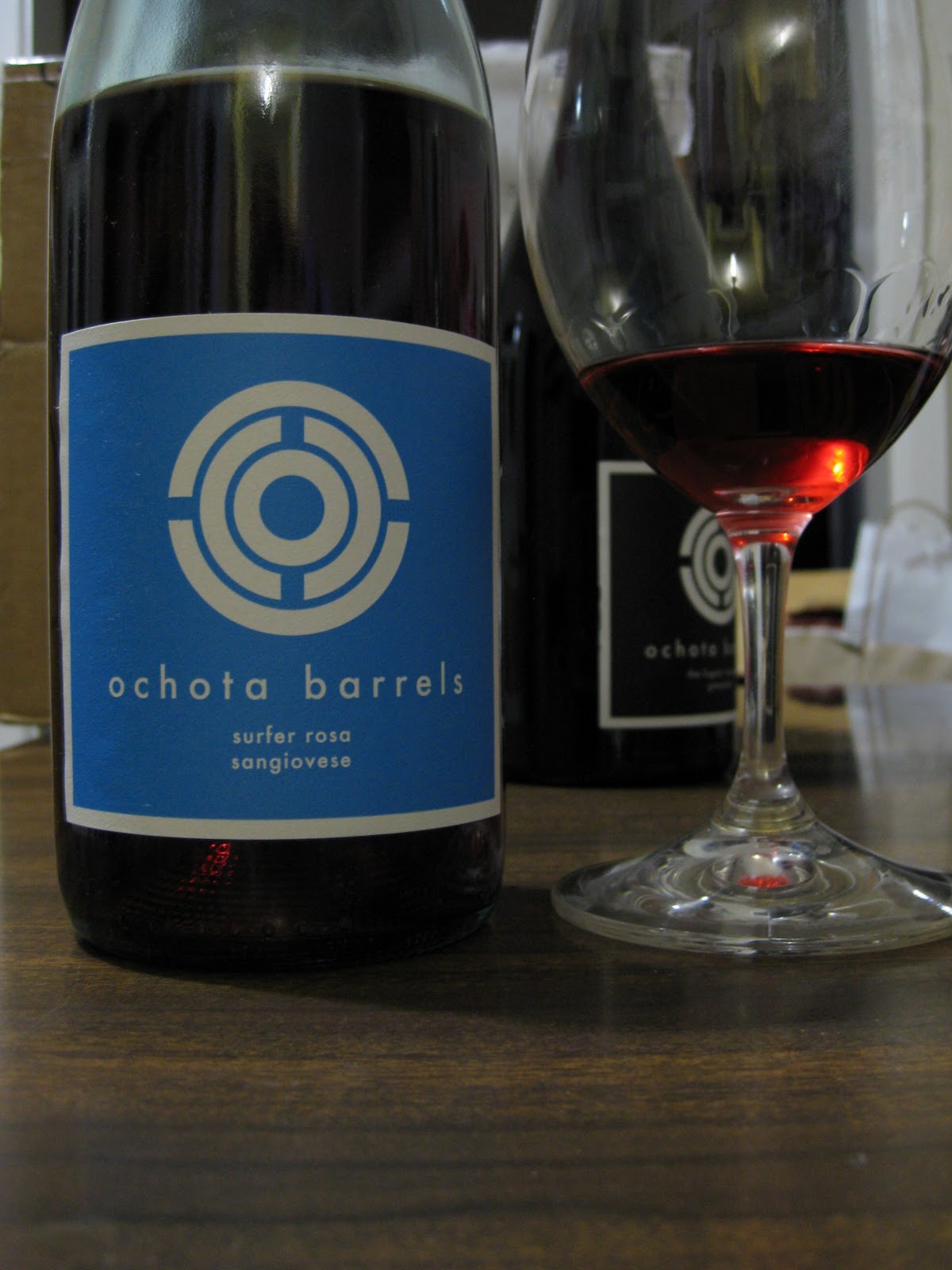
Ochota Barrels 2011 'surfer rosa' sangiovese (Adelaide Hills)
A fragment of a note from Max Allen put me onto this wine. Ochota Barrels, the wine project of Taras and Amber Ochota, is a producer I know from their initial release of grenache, but until Max's aside, I'd no idea there was a sangiovese part of the project too.
And there is another story here, apart from the generally-excellent story of Taras and Amber making wines around the world, including a stint making wines in Puglia and Sicily for a Swedish wine importer. Not to mention the time with Two Hands, Murray Street, Nepenthe, Californian producers and a winery in Southern Sweden. I kept expecting a story about the first vineyard in the Arctic Circle...
The most recent story has to do with a trip in Mexico and a decision to stay sticking together things surf and wine, which somehow leads to taking the best McLaren Vale grenache and the best Barossa shiraz and making the best wines they can, from the best stuff, from the best places... all of which makes sense, but none of which makes obvious sense for a sangiovese from the Adelaide Hills.
But this wine does make sense - a whole lot of sense. All 1168 bottles of sense. 110 cases of falling for a small parcel of fruit then swinging through some very different (for Australian sangiovese) wine making. It looks like a darker-rose, to start with. It's bottled in blue glass with a snappy blue label. It has barely a brush with sulphur. The fruit was handpicked in June. Not summer-June. There is 1% of Arneis skins included (bagged & frozen three weeks earlier just for this purpose). It has 20% whole bunches, a seven day cold-soak and a a wild yeast ferment.
It spent 77 days on skins. Days. There is tannin rippling all through this wine, pulling along beautiful, crunchy-fresh acids. There is sangiovese fruit in fleshy display ('vamping' as Taras puts it) but nothing plush or reliant on sweet-ripeness of fruit. Basket pressed, settled and bottled with speed.
Light, yet intricate, this is a $25 bottle of mesmerising fun. I've not tried an Australian sangiovese remotely like it. Get onto this.
$25, winery purchase, screwcap, 12.5% alcohol. Bottle 234 of 1168 tasted. Two more to go, which won't make it past Christmas.
And there is another story here, apart from the generally-excellent story of Taras and Amber making wines around the world, including a stint making wines in Puglia and Sicily for a Swedish wine importer. Not to mention the time with Two Hands, Murray Street, Nepenthe, Californian producers and a winery in Southern Sweden. I kept expecting a story about the first vineyard in the Arctic Circle...
The most recent story has to do with a trip in Mexico and a decision to stay sticking together things surf and wine, which somehow leads to taking the best McLaren Vale grenache and the best Barossa shiraz and making the best wines they can, from the best stuff, from the best places... all of which makes sense, but none of which makes obvious sense for a sangiovese from the Adelaide Hills.
But this wine does make sense - a whole lot of sense. All 1168 bottles of sense. 110 cases of falling for a small parcel of fruit then swinging through some very different (for Australian sangiovese) wine making. It looks like a darker-rose, to start with. It's bottled in blue glass with a snappy blue label. It has barely a brush with sulphur. The fruit was handpicked in June. Not summer-June. There is 1% of Arneis skins included (bagged & frozen three weeks earlier just for this purpose). It has 20% whole bunches, a seven day cold-soak and a a wild yeast ferment.
It spent 77 days on skins. Days. There is tannin rippling all through this wine, pulling along beautiful, crunchy-fresh acids. There is sangiovese fruit in fleshy display ('vamping' as Taras puts it) but nothing plush or reliant on sweet-ripeness of fruit. Basket pressed, settled and bottled with speed.
Light, yet intricate, this is a $25 bottle of mesmerising fun. I've not tried an Australian sangiovese remotely like it. Get onto this.
$25, winery purchase, screwcap, 12.5% alcohol. Bottle 234 of 1168 tasted. Two more to go, which won't make it past Christmas.
Labels:
2011,
adelaide hills,
Australian wine,
Ochota Barrels,
sangiovese
Subscribe to:
Posts (Atom)