The 2011 vintage release of sangiovese from Ochota Barrels was outstanding. Lithe, nervy acidy, persistent flavour, sinewy tannins - a whole new face for South Australian sangiovese. The 2012 is sangiovese with makeup on. It really, really, wants to go to a party and have people say nice things about how it looks.
Taras Ochota has made wine from Puglia and Sicily and there is perhaps a
hint of Sardinian Cannonau going on here (though Sicily also grows
grenache). The Adelaide Hills are the source of the sangiovese fruit in both the 2011 and 2012 releases. It is good fruit. The big difference here is the presence of grenache from the Onkaparinga Hills. The 2012 is still a red-fruited wine, about cherries and raspberries. The grenache adds a candied cherry and sweet-fruited raspberry to the crisp line of the sangiovese, as well as backing off the tannins and acid. Low in alcohol (12.2%) but ripe, nothing green, this is fruit-forward, acid second, tannins in the rear.
The result is more crowd-pleasing, easier to drink, than the challenging 2011. But take it to a party. Leave the 2011 for serious romance & a picnic rug.
Screwcap, gift, about $25, 12.2% alcohol, website here.
Showing posts with label Australian wine. Show all posts
Showing posts with label Australian wine. Show all posts
Monday, February 4, 2013

Sunday, February 3, 2013
Montevecchio Rosso 2011 (Heathcote)
Montevecchio is a new brand from the Chalmers family - one of the driving forces behind alternative varieties in Australia, both with their Chalmers Wines brand, their previous vineyard and nursery, and their support for the Australian Alternative Varieties Wine Show.
The Chalmers sold their original vineyard (from where I bought sagrantino fruit in 2007) to Macquarie. While much of the nursery stocks of rare clones, including the MAT clones imported from Italy, has since been bulldozed, the family also set up a Heathcote vineyard with a mixture of Italian and other varieties.
My first impression of the title 'Montevecchio' had me wondering if there was a chance of this being an exercise in passing off Australian fruit, winemaking and wines as if it were an Italian brand. But given the age of the Heathcote soils, the Mount Carmel range, and the clear badging of 'Heathcote, Victoria' on the front labels of the red and white blends and the moscato, I think this passes well.
The 2011 Rosso is described as a 'co-fermented field blend of hand-picked shiraz, lagrein, nero d'Avola and sagrantino'. The description has me wondering how many purchasers and drinkers would understand what 'field blend' might mean (not to mention co-fermentation)? Were the grapes picked at the same time and co-fermented as a single batch? Picked from one, mixed-block, or several mono-varietal plantings? Lots of room to move under that 'field blend' label, really.
Anyway, this is a wine of the cool, wet vintage rather than of the varieties involved. There is a bright, clean flow of light, crisp fruit all through the palate here. A pleasant, sour-fizz confectionery note is the main appeal. This is jug wine, in a good way, and has me thinking tapas as much as antipasti.
Purchase, $20, screwcap, 12.5% alcohol, website here.
The Chalmers sold their original vineyard (from where I bought sagrantino fruit in 2007) to Macquarie. While much of the nursery stocks of rare clones, including the MAT clones imported from Italy, has since been bulldozed, the family also set up a Heathcote vineyard with a mixture of Italian and other varieties.
My first impression of the title 'Montevecchio' had me wondering if there was a chance of this being an exercise in passing off Australian fruit, winemaking and wines as if it were an Italian brand. But given the age of the Heathcote soils, the Mount Carmel range, and the clear badging of 'Heathcote, Victoria' on the front labels of the red and white blends and the moscato, I think this passes well.
The 2011 Rosso is described as a 'co-fermented field blend of hand-picked shiraz, lagrein, nero d'Avola and sagrantino'. The description has me wondering how many purchasers and drinkers would understand what 'field blend' might mean (not to mention co-fermentation)? Were the grapes picked at the same time and co-fermented as a single batch? Picked from one, mixed-block, or several mono-varietal plantings? Lots of room to move under that 'field blend' label, really.
Anyway, this is a wine of the cool, wet vintage rather than of the varieties involved. There is a bright, clean flow of light, crisp fruit all through the palate here. A pleasant, sour-fizz confectionery note is the main appeal. This is jug wine, in a good way, and has me thinking tapas as much as antipasti.
Purchase, $20, screwcap, 12.5% alcohol, website here.
Saturday, January 26, 2013
Pizzini Nebbiolo 2001 (King Valley)
One of the reasons for this blog is to taste and write about aged examples of Australian wines made from Italian grape varieties. This early example of a Pizzini nebbiolo has come to a point of gentle, assured, aged-wine drinking. Nothing showy - good, light nebbiolo fragrances of roses steeped in tea, dried orange peel, the lightest touch of leather - and a fine balance of acid and tannin. Some refreshment here too, and a polite foil for braised beef & polenta or cous cous.
So add another tick of evidence in the column for the age-worthiness of Australian nebbiolo. Drink over the next year or two if you still have some.
Cork, purchase, $45, 13.8% alcohol.
Post script: An intriguing claim sits on the front label of this wine - 'Nebbiolo's aristocratic personality has asserted its supremacy over other wines'. Some irony in the bombast of that claim being in direct contrast to the gentle, understated, assured character of this as an aged wine... Nebbiolo not as a domineering lecture, but a good conversation.
So add another tick of evidence in the column for the age-worthiness of Australian nebbiolo. Drink over the next year or two if you still have some.
Cork, purchase, $45, 13.8% alcohol.
Post script: An intriguing claim sits on the front label of this wine - 'Nebbiolo's aristocratic personality has asserted its supremacy over other wines'. Some irony in the bombast of that claim being in direct contrast to the gentle, understated, assured character of this as an aged wine... Nebbiolo not as a domineering lecture, but a good conversation.
Monday, October 8, 2012
Yalumba Y Series Vermentino 2011
Yalumba's work with viognier might offer a path for pushing an Italian white into an Australian mass market. The bet is on with vermentino. It might even pay off.
There is a bit to smell here: citrus blossom & light jasmine. But it's discrete. No hothouse rush up the glass like a malvasia or sauvignon pungency. The palate is even, citrus again, with a bit of citrus pith and a decidedly salty character I find distracting. Just a bit of chalky texture on the way out.
Good value if you get it closer to $10 than the rrp of $14.95. There's refreshment, but that salty note distracts like a skipping track on a compact disc. Screwcap.
There is a bit to smell here: citrus blossom & light jasmine. But it's discrete. No hothouse rush up the glass like a malvasia or sauvignon pungency. The palate is even, citrus again, with a bit of citrus pith and a decidedly salty character I find distracting. Just a bit of chalky texture on the way out.
Good value if you get it closer to $10 than the rrp of $14.95. There's refreshment, but that salty note distracts like a skipping track on a compact disc. Screwcap.
Saturday, September 15, 2012
Greenstone 2010 Colorino (Heathcote)
This is the most exciting bottle of wine I have seen out of Heathcote. Colorino is one of the varieties traditionally blended with sangiovese to make Chianti. Colorino, along with other varieties such as Canaiolo, is seldom seen as a single-variety wine and Mark Walpole's Heathcote plantings have produced Australia's first straight bottling of this deeply coloured and well flavoured variety.
I first saw this wine about ten months ago at the Australian Alternative Varieties Wine Show in Mildura, where it was the pick of the show stewards. In the intervening time, the plush waves of primary fruit have settled back a bit, revealing some of the character and detail in the wine. Purple fruits, flecked with red and black, now sit behind layers of good smells, including fresh bramble berries and a distinct blueberry perfume. Tannins are there, giving the deep colour and sturdy fruit rails to slide along. It is a wine of genuine interest and real refreshment. Hard to recall the last time I had a wine from Heathcote that could balance fruit, intensity and refreshment this well. The 13% alcohol may have something to do with this.
Hard to judge how this would age. Perhaps best to drink in the next two or three years, before that primary fruit backs away further.
And to finish, a story from Mark Walpole, one of the partners in Greenstone and a pioneer of Italian varieties in Australia. Usually, this fruit would be blended into the Greenstone sangiovese, for colour and other benefits. But in 2010, even a small blending knocked the sangiovese off its axis. The Colorino was too much, too assertive, too different and insistent on telling its own story. So a separate bottling for the first time.
Which brings me back to one of the questions threading through this blog: what if the Italian varieties that could perform best in Australia are not the standard front-runners from within Italy and the global experience of Italian varieties? Could some of these 'other' Italian varieties not just do better in Australia than back home, but what if they were able to outperform nebbiolo and sangiovese?
Sample. Screwcap. 13% alcohol. Should be $25-30 in retail.
I first saw this wine about ten months ago at the Australian Alternative Varieties Wine Show in Mildura, where it was the pick of the show stewards. In the intervening time, the plush waves of primary fruit have settled back a bit, revealing some of the character and detail in the wine. Purple fruits, flecked with red and black, now sit behind layers of good smells, including fresh bramble berries and a distinct blueberry perfume. Tannins are there, giving the deep colour and sturdy fruit rails to slide along. It is a wine of genuine interest and real refreshment. Hard to recall the last time I had a wine from Heathcote that could balance fruit, intensity and refreshment this well. The 13% alcohol may have something to do with this.
Hard to judge how this would age. Perhaps best to drink in the next two or three years, before that primary fruit backs away further.
And to finish, a story from Mark Walpole, one of the partners in Greenstone and a pioneer of Italian varieties in Australia. Usually, this fruit would be blended into the Greenstone sangiovese, for colour and other benefits. But in 2010, even a small blending knocked the sangiovese off its axis. The Colorino was too much, too assertive, too different and insistent on telling its own story. So a separate bottling for the first time.
Which brings me back to one of the questions threading through this blog: what if the Italian varieties that could perform best in Australia are not the standard front-runners from within Italy and the global experience of Italian varieties? Could some of these 'other' Italian varieties not just do better in Australia than back home, but what if they were able to outperform nebbiolo and sangiovese?
Sample. Screwcap. 13% alcohol. Should be $25-30 in retail.
Saturday, September 1, 2012
Show sophistry
Wine shows, and the Australian systems of them, seem to be somewhat topical at the moment. Some of the dullest wine topics imaginable ensue, front-running being whether to score wines out of 100 or 20, or perhaps 20 with small increments. The usual shibboleths trot their way out onto stage: shows are about 'improving the breed' of wines, shows are important for communicating to consumers about wines... I could go on.
But maybe there is a different kind of conversation available here. What if we started at the point of admitting the real reasons why the show system continues to function in Australia, and then went on to ask if there are other arrangements that could better meet those functions? What if we had no wine show system at all, but delivered the system's benefits (such as they are) in a different way?
Take 'improving the breed'. It's a fig leaf. The wines aren't the breed being improved. It is the people. That's the breed. The show system currently functions as a mechanism for 'training' wine people in wine opinion, including how to express those opinions and how to keep fitting in with shifting taste cultures. Some of this training function extends to people employed in wine but not currently judges or associate judges, through mechanisms such as stewarding and exhibitor's tastings.
The wines themselves are not the breed being 'improved'. What happens to the wines is a crapshoot. Assessments simply cannot be 'objective' or science-based under show judging conditions. Too many wines to taste, too little time, the absence of food, classed in muddles of different climates and styles, subject to the stylistic whims of un-published panel directions, taste assessments made about measurable attributes that then cannot be supported by measured evidence... It is an inherently-flawed process if the objective is to improve the breed of wines. It accelerates wine fads and style shifts, under the guise of vague rising-tide, all-boats-a-lifting metaphors. 'Elegant' cabernet, ripe shiraz from warm climes, rose that cannot be from bleeding juice, chardonnay full of bones or splinters... there is no linear trajectory of 'quality improvement' here, driven by the show system.
If we faced up to the function of the show system being to form and reform the people involved, to shape cultures of taste, then could we really say the show system is the best way to do it? Is it sensible trying to acquit what is really an educative and social-networking function by having wineries subsidise agricultural show societies who then subsidise wine people to drink together and learn from each other?
What would happen if every Australian wine producer put their budgets for samples, costs, staff time and travel related to wineshows into better education and training, including in local networks? More region-wide events for people in the wine game, buying in samples of wines for collaborative benchmarking exercises. More cross-region exchanges of information, including scientific and subjective information, could be funded through mechanisms more efficient and more proximate to the wine industry than outsourcing this to agricultural societies.
Would anyone in wine notice much of a difference in their sales and marketing from the absence of the shows, from the cursory or illusory marketing efforts of the show societies? I suspect the show societies would feel a loss from ripping up the current system and starting again, from scratch, at figuring out better ways to 'improve the breed' of wine knowledge and creativity. It might mean fewer exposures to the great and expensive wines of the world for some judges, subsidised by growers and wine businesses whose own people end up locked out of these experiences. But what if an alternative to the show system meant better, more capable people in Australian wine, leading to better wines as a result?
What do I come back to? The system does not do what it says it does. It accentuates faddish trends. It rips people off. It hides lifestyle subsidies for a privileged few. It is shockingly poor value for Australian wine businesses that send in samples. So tear it up. Boycott the shows. Let them wither and die. Face up to the hidden functions the system still serves, like improving the 'human breed' in Australian wine. And ask, squarely and clearly, if the real aim is people, their knowledge, networks and learning, then what is a better set of arrangements and institutions to get those benefits.
Australian wine, and those that drink it, deserve better.
But maybe there is a different kind of conversation available here. What if we started at the point of admitting the real reasons why the show system continues to function in Australia, and then went on to ask if there are other arrangements that could better meet those functions? What if we had no wine show system at all, but delivered the system's benefits (such as they are) in a different way?
Take 'improving the breed'. It's a fig leaf. The wines aren't the breed being improved. It is the people. That's the breed. The show system currently functions as a mechanism for 'training' wine people in wine opinion, including how to express those opinions and how to keep fitting in with shifting taste cultures. Some of this training function extends to people employed in wine but not currently judges or associate judges, through mechanisms such as stewarding and exhibitor's tastings.
The wines themselves are not the breed being 'improved'. What happens to the wines is a crapshoot. Assessments simply cannot be 'objective' or science-based under show judging conditions. Too many wines to taste, too little time, the absence of food, classed in muddles of different climates and styles, subject to the stylistic whims of un-published panel directions, taste assessments made about measurable attributes that then cannot be supported by measured evidence... It is an inherently-flawed process if the objective is to improve the breed of wines. It accelerates wine fads and style shifts, under the guise of vague rising-tide, all-boats-a-lifting metaphors. 'Elegant' cabernet, ripe shiraz from warm climes, rose that cannot be from bleeding juice, chardonnay full of bones or splinters... there is no linear trajectory of 'quality improvement' here, driven by the show system.
If we faced up to the function of the show system being to form and reform the people involved, to shape cultures of taste, then could we really say the show system is the best way to do it? Is it sensible trying to acquit what is really an educative and social-networking function by having wineries subsidise agricultural show societies who then subsidise wine people to drink together and learn from each other?
What would happen if every Australian wine producer put their budgets for samples, costs, staff time and travel related to wineshows into better education and training, including in local networks? More region-wide events for people in the wine game, buying in samples of wines for collaborative benchmarking exercises. More cross-region exchanges of information, including scientific and subjective information, could be funded through mechanisms more efficient and more proximate to the wine industry than outsourcing this to agricultural societies.
Would anyone in wine notice much of a difference in their sales and marketing from the absence of the shows, from the cursory or illusory marketing efforts of the show societies? I suspect the show societies would feel a loss from ripping up the current system and starting again, from scratch, at figuring out better ways to 'improve the breed' of wine knowledge and creativity. It might mean fewer exposures to the great and expensive wines of the world for some judges, subsidised by growers and wine businesses whose own people end up locked out of these experiences. But what if an alternative to the show system meant better, more capable people in Australian wine, leading to better wines as a result?
What do I come back to? The system does not do what it says it does. It accentuates faddish trends. It rips people off. It hides lifestyle subsidies for a privileged few. It is shockingly poor value for Australian wine businesses that send in samples. So tear it up. Boycott the shows. Let them wither and die. Face up to the hidden functions the system still serves, like improving the 'human breed' in Australian wine. And ask, squarely and clearly, if the real aim is people, their knowledge, networks and learning, then what is a better set of arrangements and institutions to get those benefits.
Australian wine, and those that drink it, deserve better.
Wednesday, August 22, 2012
Vinea Marson Sangiovese 2009 (Heathcote)
Recently, as well as getting through pruning, I have been reading Kerin O'Keefe's book on Brunello di Montalcino. Drinking the 2009 Vinea Marson Heathcote sangiovese brings to mind some of the wines O'Keefe writes about as too rich, too dark to be Brunello. To me, some difference is fine in an Australian sangiovese, as surely there are paths with this grape that do not start in Chianti and end at Montalcino.
But the wine, even stating a 13.5% alcohol, looks like Heathcote and warm weather to me, more so than varietal sangiovese. It is a good wine, will age well and sat up straight next to braised beef. The tannins say sangiovese but the heart of deeply purple, verging on black, fruits says something else.
Not $44 of value here, for mine.
But the wine, even stating a 13.5% alcohol, looks like Heathcote and warm weather to me, more so than varietal sangiovese. It is a good wine, will age well and sat up straight next to braised beef. The tannins say sangiovese but the heart of deeply purple, verging on black, fruits says something else.
Not $44 of value here, for mine.
Monday, June 4, 2012
Vigna Cantina 2011 Trebbiano (Barossa Valley)
A sample bottle, courtesy of Mr Torzi, the man behind Torzi Matthews Vintners and the Vigna Cantina label.
Bottled under screwcap this has a brisk, fresh profile of lively acid over trebbiano fruit. The cool and wet year shows in the acid-first, fruit-second swing of the wine through your mouth. Whereas warmer years or sites, plus deft hands in the vineyard, can deliver a characteristic waxy texture in trebbiano (as was the case in the 2010 version of this wine), the 2011 has a different feel, almost like lemon sherbert. Deft hands show here too, as it feels like a swap of textures across the vintages, rather than two unrelated wines.
From 106 year old vines at Altona and Koonunga Dunes in the Barossa. Try with grilled fish or salt and pepper squid. $22 rrp. 12.5% alcohol.
I reviewed the 2010 vintage here.
Bottled under screwcap this has a brisk, fresh profile of lively acid over trebbiano fruit. The cool and wet year shows in the acid-first, fruit-second swing of the wine through your mouth. Whereas warmer years or sites, plus deft hands in the vineyard, can deliver a characteristic waxy texture in trebbiano (as was the case in the 2010 version of this wine), the 2011 has a different feel, almost like lemon sherbert. Deft hands show here too, as it feels like a swap of textures across the vintages, rather than two unrelated wines.
From 106 year old vines at Altona and Koonunga Dunes in the Barossa. Try with grilled fish or salt and pepper squid. $22 rrp. 12.5% alcohol.
I reviewed the 2010 vintage here.
Sunday, April 1, 2012
Yarrh 2004 sangiovese (Canberra)
The Yarrh vineyard is an attractive, gum-treed site wrapped around by bush and not far from Ken Helm's Murrumbateman cellar door. Sangiovese is a strict mistress in regions marginal for it, such as Canberra. Everything has to line up: soil, water, vine health, bud counts, shoot vigour, shoot length, fruit load, season. Bryan Martin, of Ravensworth fame (and a big part of Clonakilla) has shown how sangiovese can perform in Canberra, but this wine fleshes out that story.
Maybe a sign of the Canberra roots I've put down, I've been having a bottle or two of this most years for the past seven years. Like old jackets shift smells and change their fit over years, seeing and feeling the aging path of this wine has been a satisfying thing. Tight and red-fruited, with a hint of something dried-herb & tobacco as a younger wine, this has aged well (though my bottle before this one had largely fallen over). In it's old age, this has become more local and less varietal, without losing overall appeal. The wine now shows aged red fruit, a touch of leather & mint, and something elusive, nutty & sweet, like a toffeed hazelnut. A good showing, from what I think is my last bottle. Congratulations to the winemaker, Fiona Wholohan, and the site.
A satisfying, if surprising pairing for this: bucatini in a sauce of onion, zucchini dice, black pepper and gorgonzola dolce, thinned with pasta water. The aged, nutty, toffee character of the wine made an excellent fit with the sweet yet blue cheese of the sauce and the comparative bitter of zucchini skin.
Maybe a sign of the Canberra roots I've put down, I've been having a bottle or two of this most years for the past seven years. Like old jackets shift smells and change their fit over years, seeing and feeling the aging path of this wine has been a satisfying thing. Tight and red-fruited, with a hint of something dried-herb & tobacco as a younger wine, this has aged well (though my bottle before this one had largely fallen over). In it's old age, this has become more local and less varietal, without losing overall appeal. The wine now shows aged red fruit, a touch of leather & mint, and something elusive, nutty & sweet, like a toffeed hazelnut. A good showing, from what I think is my last bottle. Congratulations to the winemaker, Fiona Wholohan, and the site.
A satisfying, if surprising pairing for this: bucatini in a sauce of onion, zucchini dice, black pepper and gorgonzola dolce, thinned with pasta water. The aged, nutty, toffee character of the wine made an excellent fit with the sweet yet blue cheese of the sauce and the comparative bitter of zucchini skin.
Wednesday, March 7, 2012
Hamilton's Bluff Sangiovese 2005 (Canowindra)
The Hamilton's Bluff vineyard at Canowindra can turn out the goods with sangiovese. Not too close to the richer, wetter and hotter parts of the district (near Cowra in NSW), there is vigour enough for the vines without washing out colour and flavour. But what I have enjoyed about the couple of vintages of this I have had, including this 2005, is that there is a distinctiveness to the wine. It has a softly-aged richness of texture, something gently-creamy about it, that is genuinely appealing. As well as being an excellent example of graceful aging under screwcap, at around $25 a bottle this is both good value and a good return to the people who grew the fruit, made the wine and brought it out to market in its prime. Roast lamb with borlotti beans cooked off in the tray at the end of the roast makes a good match, or just good bread & a bottle of spicy olive oil.
Their website is worth a look, both for the wine and Julia Andrews' writing about their vineyard, business and local area. Personal and personable.
Their website is worth a look, both for the wine and Julia Andrews' writing about their vineyard, business and local area. Personal and personable.
Tuesday, December 6, 2011
Ochota Barrels 2011 'surfer rosa' sangiovese (Adelaide Hills)
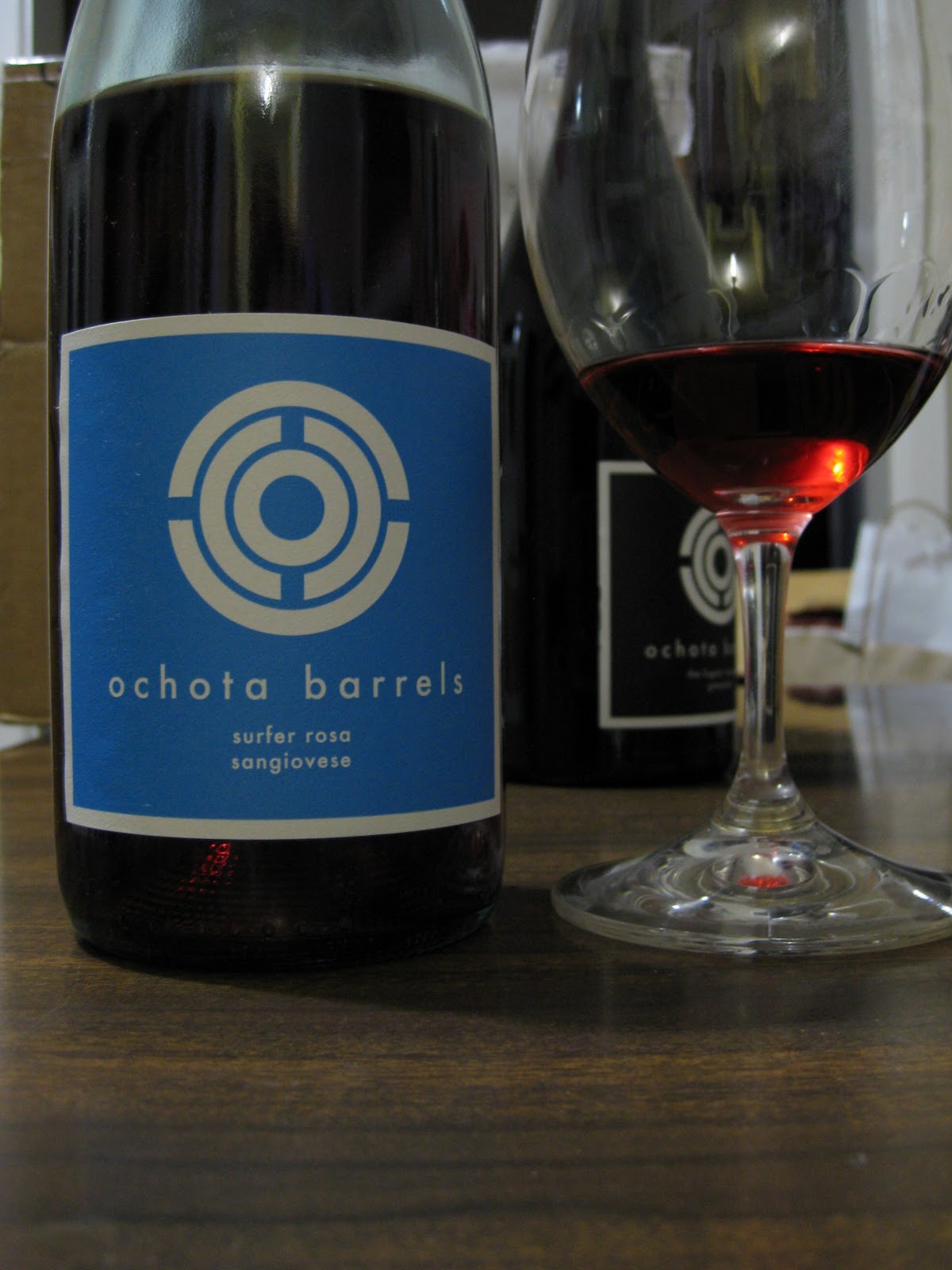
And there is another story here, apart from the generally-excellent story of Taras and Amber making wines around the world, including a stint making wines in Puglia and Sicily for a Swedish wine importer. Not to mention the time with Two Hands, Murray Street, Nepenthe, Californian producers and a winery in Southern Sweden. I kept expecting a story about the first vineyard in the Arctic Circle...
The most recent story has to do with a trip in Mexico and a decision to stay sticking together things surf and wine, which somehow leads to taking the best McLaren Vale grenache and the best Barossa shiraz and making the best wines they can, from the best stuff, from the best places... all of which makes sense, but none of which makes obvious sense for a sangiovese from the Adelaide Hills.
But this wine does make sense - a whole lot of sense. All 1168 bottles of sense. 110 cases of falling for a small parcel of fruit then swinging through some very different (for Australian sangiovese) wine making. It looks like a darker-rose, to start with. It's bottled in blue glass with a snappy blue label. It has barely a brush with sulphur. The fruit was handpicked in June. Not summer-June. There is 1% of Arneis skins included (bagged & frozen three weeks earlier just for this purpose). It has 20% whole bunches, a seven day cold-soak and a a wild yeast ferment.
It spent 77 days on skins. Days. There is tannin rippling all through this wine, pulling along beautiful, crunchy-fresh acids. There is sangiovese fruit in fleshy display ('vamping' as Taras puts it) but nothing plush or reliant on sweet-ripeness of fruit. Basket pressed, settled and bottled with speed.
Light, yet intricate, this is a $25 bottle of mesmerising fun. I've not tried an Australian sangiovese remotely like it. Get onto this.
$25, winery purchase, screwcap, 12.5% alcohol. Bottle 234 of 1168 tasted. Two more to go, which won't make it past Christmas.
Sunday, November 27, 2011
Sangiovese at the 2011 AAVWS #1
Class 15A of the Australian Alternative Varieties Wine Show (AAVWS) covered 2010 and 2011 sangiovese. In much of the country, 2011 was not a good vintage for sangiovese, with fruit suffering under the disease pressures of cool and wet. But 2010 was a different story, many regions having a break from heatwave, drought, frost and other difficult conditions.
This was a small class of 14 entries. Some wines definitely needed more time to come up (like the 2010 Vigna Cantina), but my general impression of the class was poor. From what I saw under show conditions, the wines I would buy were:
- 2010 Chalk Hill sangiovese (McLaren Vale, stainless steel, then large-format old oak), which took a bronze from the judges
- 2010 Coriole sangiovese (McLaren Vale, strong showing, well worth a gold medal, which it received)
- 2010 Watershed Premium Wines 'Senses' sangiovese (Margaret River, the other gold medal awarded).
It is useful to look at the prices as well as the regions here. The Coriole has a $25 rrp but will often retail at about $20 a bottle if you look. The Chalk Hill is a $22 rrp. $25 for the Watershed. These wines can hit a good balance of quality and price point - something I still think is a fundamental problem with quite a bit of Australian sangiovese. Of the three, the Chalk Hill could afford to dial the 15.5% alcohol back, but did not really show distorting heat that much. The Watershed made me think I need to have a closer look at Italian varieties coming out of WA (the Juniper Estate Tempranillo extending that case into Spain).
This was a small class of 14 entries. Some wines definitely needed more time to come up (like the 2010 Vigna Cantina), but my general impression of the class was poor. From what I saw under show conditions, the wines I would buy were:
- 2010 Chalk Hill sangiovese (McLaren Vale, stainless steel, then large-format old oak), which took a bronze from the judges
- 2010 Coriole sangiovese (McLaren Vale, strong showing, well worth a gold medal, which it received)
- 2010 Watershed Premium Wines 'Senses' sangiovese (Margaret River, the other gold medal awarded).
It is useful to look at the prices as well as the regions here. The Coriole has a $25 rrp but will often retail at about $20 a bottle if you look. The Chalk Hill is a $22 rrp. $25 for the Watershed. These wines can hit a good balance of quality and price point - something I still think is a fundamental problem with quite a bit of Australian sangiovese. Of the three, the Chalk Hill could afford to dial the 15.5% alcohol back, but did not really show distorting heat that much. The Watershed made me think I need to have a closer look at Italian varieties coming out of WA (the Juniper Estate Tempranillo extending that case into Spain).
Tuesday, November 22, 2011
Vigna Cantina 2010 Sangiovese (Barossa Valley)
Here is a wine that requires a bit of time to show itself (and to get its measure). Vigna Cantina is the 'Italian' label of Torzi Matthews, with the range also including a good old-vine trebbiano. The Barossa has some older-vine sangiovese to work with, including on sandier soils that can help balance out the vines at sensible cropping levels. Some of the vines Penfolds have used for their Cellar Reserve Sangiovese were experimental Kalimna plantings put in in 1982. Apparently, there are a few early trial wines made that never saw external release... Wonder what they were (or are) like?
But back to Vigna Cantina. These vines, at Moppa Springs and Koonunga Hill in the Barossa, come in at 15 years of age and are cropped moderately (2.5kg per vine). Winemaking choices are similar to the 2009 version of this wine (reviewed here) - whole berries, 30% whole bunch, wild yeasts, small open ferments, basket pressed and taken to bottle unfiltered.
The wine itself shows a good balance of fruit character, acid and light, burring tannins, but needs time in the decanter or glass to come up (a couple of years in the cellar could work too). As a pop-and-pour, it can look a touch under-fruited, with a note of something lifted, almost volatile. Perhaps as a result of the wild yeast ferment, this lifted character (not VA for me) can be a bit distracting, but with time the purple and red fruits well up nicely to balance things out. A good wine, straddling the categories of sangiovese and Barossan dry red, and decent drinking with time and grilled meats. Sensible alcohol a further plus.
Sample, $22 recommended retail price, screwcap, 13.5% alcohol. Winery website here.
But back to Vigna Cantina. These vines, at Moppa Springs and Koonunga Hill in the Barossa, come in at 15 years of age and are cropped moderately (2.5kg per vine). Winemaking choices are similar to the 2009 version of this wine (reviewed here) - whole berries, 30% whole bunch, wild yeasts, small open ferments, basket pressed and taken to bottle unfiltered.
The wine itself shows a good balance of fruit character, acid and light, burring tannins, but needs time in the decanter or glass to come up (a couple of years in the cellar could work too). As a pop-and-pour, it can look a touch under-fruited, with a note of something lifted, almost volatile. Perhaps as a result of the wild yeast ferment, this lifted character (not VA for me) can be a bit distracting, but with time the purple and red fruits well up nicely to balance things out. A good wine, straddling the categories of sangiovese and Barossan dry red, and decent drinking with time and grilled meats. Sensible alcohol a further plus.
Sample, $22 recommended retail price, screwcap, 13.5% alcohol. Winery website here.
Friday, September 23, 2011
Castagna Sauvage 2003
The Castagna description of the makeup of this wine: "Made from single-vineyard, estate-grown shiraz, with a touch of viognier and a dollop of sangiovese."
I recently had my last bottle of this, which is essentially de-classified Castagna shiraz from the smoke-hit 2003 vintage in Beechworth. Unlike most of the smoke-year wines I've had, this did improve with age. There are smoke characters here, but they thread and fold through a wine of real interest. A meaty wine, wildness with a spit-shine.
Not until this last bottle did I really have a sense that there was sangiovese at work here, but I am now thinking that perhaps the savoury note it provides, as well as the different line of tannin and acid, played a crucial part in balancing out the pretty characters of shiraz-viognier and the smoke below.
Anyway, my few bottles of this, drunk over several years, have been fascinating and thought-provoking, including to my preconception that smokey wines are best used as marinades.
I recently had my last bottle of this, which is essentially de-classified Castagna shiraz from the smoke-hit 2003 vintage in Beechworth. Unlike most of the smoke-year wines I've had, this did improve with age. There are smoke characters here, but they thread and fold through a wine of real interest. A meaty wine, wildness with a spit-shine.
Not until this last bottle did I really have a sense that there was sangiovese at work here, but I am now thinking that perhaps the savoury note it provides, as well as the different line of tannin and acid, played a crucial part in balancing out the pretty characters of shiraz-viognier and the smoke below.
Anyway, my few bottles of this, drunk over several years, have been fascinating and thought-provoking, including to my preconception that smokey wines are best used as marinades.
Thursday, September 22, 2011
Canberra Italians (at the wine show)
So, what does the 2011 Canberra Regional Wine Show results have to say about Italian grapes in the Canberra District and surrounds? Surrounds includes Tumbarumba, Hilltops, Gundagai, Southern Highlands and the South Coast of NSW, give or take.
Class 4 covers 'other' white varieties and blends, from the 2011 vintage. Pinot gris and grigio took the top gongs: gold for the Mount Majura Pinot Gris; silver for Lerida Estate's pinot grigio; and silver for Southern Highland Wines'gris. The Mount Majura is my pick: tight, expressive, fragrant with green pear.
Three of the 14 wines entered in Class 17 (2010 other varieties or blends) were sangiovese. Both Ravensworth and Pankhurst Wines entered a straight sangiovese, with a shiraz sangiovese blend from Little Bridge Wines. Both the Little Bridge and Ravensworth wines picked up silver medals, with the Ravensworth being my pick of the bunch.
In the next class (#18, 2009 and older other reds or blends), the 2009 Ravensworth sangiovese picked up a bronze. The other Italians (A.Retief's shiraz, sangiovese, malbec from 2008 and Grove Estate's 2009 Sommita Nebbiolo) in this class didn't grab a medal. For what it's worth, I preferred the 2009 Ravensworth sangiovese over the 2010 version - both wines crying out for food and a bit of time.
And that was it. Given the small number of Italians or blends of Italian and other varieties entered, the hit rate was not too bad, but none of these wines really took the event by the scruff. Out of what I tasted, the Mount Majura pinot gris and the Ravensworth sangiovese wines are what I would recommend and buy.
Class 4 covers 'other' white varieties and blends, from the 2011 vintage. Pinot gris and grigio took the top gongs: gold for the Mount Majura Pinot Gris; silver for Lerida Estate's pinot grigio; and silver for Southern Highland Wines'gris. The Mount Majura is my pick: tight, expressive, fragrant with green pear.
Three of the 14 wines entered in Class 17 (2010 other varieties or blends) were sangiovese. Both Ravensworth and Pankhurst Wines entered a straight sangiovese, with a shiraz sangiovese blend from Little Bridge Wines. Both the Little Bridge and Ravensworth wines picked up silver medals, with the Ravensworth being my pick of the bunch.
In the next class (#18, 2009 and older other reds or blends), the 2009 Ravensworth sangiovese picked up a bronze. The other Italians (A.Retief's shiraz, sangiovese, malbec from 2008 and Grove Estate's 2009 Sommita Nebbiolo) in this class didn't grab a medal. For what it's worth, I preferred the 2009 Ravensworth sangiovese over the 2010 version - both wines crying out for food and a bit of time.
And that was it. Given the small number of Italians or blends of Italian and other varieties entered, the hit rate was not too bad, but none of these wines really took the event by the scruff. Out of what I tasted, the Mount Majura pinot gris and the Ravensworth sangiovese wines are what I would recommend and buy.
Thursday, May 19, 2011
Primo Estate Joseph Moda 1999
The cork on this has worked so well the wine shows barely any development. This could be a three year old wine, instead of one past its 11th birthday. The 10% merlot (Coonawarra & McLaren Vale) is quite evident, especially as a hit of olive & plum to taste. The tannins are still to soften - a full wall of drying grip - but the fruit has weight and stability enough to wait it out. All the cabernet for the 1999 Moda 'amarone' came from McLaren Vale, and it is good fruit. Assuming you have a good cork, this is a Moda to leave until 2015 before re-trying. 14.5% alc.
Monday, May 2, 2011
Silverfish (Primo Estate Moda 1990)
 The silverfish clearly appreciated this bottle of 1990 Primo Estate Moda 'amarone' cabernet merlot. A beautiful example of how the Moda wines can age, this was expressive and distinctly cabernet from opening. Resolved tannins with a touch of bitter-sweet to them, this was excellent drinking and showed no sign of being near the end of its life. Unlike the label.
Monday, April 4, 2011
Brown Brothers NV Prosecco (King Valley)
I have never had a wine that tasted so much of lemon sherbet. This is fairly simple and straightforward charmat-style prosecco, but none the worse for that. The wine has a final alcohol of 11% and stays bright and crisp from nose through palate and finish. The lemon sherbet flavours and characters (the pressure-tank fizz) do repay some attention. There is a fresh lemon aspect, a touch of candied lemon, and also a kind of 'chemical lemon' commercial confectionary note (much better than it sounds) all working together. Perhaps fruit of different ripeness and multiple picks from the Banksdale vineyard in the King Valley? While I'm unsure a cork closure rather than crown seal makes sense for this wine, it does the business as a $20 a bottle aperitif prosecco. Which is more than I can say for the Flash-dependent Brown Brothers website.
Update - Brown Brothers are certainly on the ball. They've advised me they are part way through removing Flash from their website, aiming to have the whole site iphone compliant. Nice work and great to have feedback from the winery at such pace.
Update - Brown Brothers are certainly on the ball. They've advised me they are part way through removing Flash from their website, aiming to have the whole site iphone compliant. Nice work and great to have feedback from the winery at such pace.
Thursday, March 17, 2011
Coriole Sagrantino 2007 (McLaren Vale)
The back label text for the 2007 Coriole sagrantino reads:
"Sagrantino is the most recent addition to Coriole's range of Italian varietals. It has a reputation for being one of the most tannic varieties in the world, but with great structure and longevity. This wine will reward patience with careful cellaring."
There's an admirable Australian directness about that reference to tannins, kind of "right, we've said it, that's out of the way now." The wine is not as tannic as the back label suggests, but it is about structure. It is also about deep fruits, purple-black but shot through with red fruits notes. Some Umbrian sagrantino (not just the blended ones) show a touch of dried herb in behind the dusty, bitter chocolate characteristic of the variety. This wine has some of that chocolate, and good persistence to go with the structure, but needs some time to fill out and add further complexity.
There is a fear among sagrantino makers and marketers from the few Australian vineyards and wineries who have it that consumers will think it too cabernet-like. Yes, it is a tannic variety, but these are not cabernet tannins. With the grip, there is a dusty, gritty, sandy, nut-skin character to the tannins that, combined with the bitter chocolate notes, make for something distinctly Italianate (and very good with braised or roast pork; Umbria is the porcine heart of Italy, after all).
If I had to try and describe good sagrantino through an Australian frame, I'd say it has the structure, length, fruit intensity, depth and persistence of a top cabernet-shiraz blend, with Italian notes throughout the nutty tannins and bitter chocolate finish. But I think I prefer the Coriole label approach - take it on its own terms, with directness and honesty.
$45, cork, winery sample, 14% alcohol.
"Sagrantino is the most recent addition to Coriole's range of Italian varietals. It has a reputation for being one of the most tannic varieties in the world, but with great structure and longevity. This wine will reward patience with careful cellaring."
There's an admirable Australian directness about that reference to tannins, kind of "right, we've said it, that's out of the way now." The wine is not as tannic as the back label suggests, but it is about structure. It is also about deep fruits, purple-black but shot through with red fruits notes. Some Umbrian sagrantino (not just the blended ones) show a touch of dried herb in behind the dusty, bitter chocolate characteristic of the variety. This wine has some of that chocolate, and good persistence to go with the structure, but needs some time to fill out and add further complexity.
There is a fear among sagrantino makers and marketers from the few Australian vineyards and wineries who have it that consumers will think it too cabernet-like. Yes, it is a tannic variety, but these are not cabernet tannins. With the grip, there is a dusty, gritty, sandy, nut-skin character to the tannins that, combined with the bitter chocolate notes, make for something distinctly Italianate (and very good with braised or roast pork; Umbria is the porcine heart of Italy, after all).
If I had to try and describe good sagrantino through an Australian frame, I'd say it has the structure, length, fruit intensity, depth and persistence of a top cabernet-shiraz blend, with Italian notes throughout the nutty tannins and bitter chocolate finish. But I think I prefer the Coriole label approach - take it on its own terms, with directness and honesty.
$45, cork, winery sample, 14% alcohol.
Tuesday, March 15, 2011
Yarrh 2004 Sangiovese (Canberra)
This wine, along with several of Bryan Martin's Ravensworth sangiovese wines, convinced me that sangiovese could be a good fit with the Canberra District. I bought a six pack and have followed them over the last six years.
The Yarrh vineyard is in Murrumbateman, closer to Ken Helm's site than it is to Clonakilla or Quarry Hill. It's a sloping site, wrapped around with native vegetation, including reveg plantings, topped off with a well-designed winery and cellar door. While the vineyard has some good air drainage, frost, disease and drought pressures, as well as sangiovese being a tricky prospect in the district, mean that a crop of quality each year is far from certain.
The 2004 as a younger wine had expressive cherry fruit and an attractive mix of nutty tannins and dried herb varietal characters. Through the bottles had between 2006 and 2009, these characters remained, topped up by a little tannin softening and bottle development. But this bottle suggested a wine on the downhill run. The nose has unstitched itself from the rest of the wine, turning dry-reddish rather than varietal. The varietal characters are still there on the palate, but they are fading, with the bones of the wine poking through.
Matched with a tray-roast of chicken thighs, onion, carrot, tomato, thyme, rosemary, oil and red vinegar, the wine clearly had its best days behind it. Still drinkable, it has lost the characters that attracted me to it over the past four bottles. Still good to follow these wines over time though.
Yarrh Wines, $25, screwcap, 14% alcohol.
The Yarrh vineyard is in Murrumbateman, closer to Ken Helm's site than it is to Clonakilla or Quarry Hill. It's a sloping site, wrapped around with native vegetation, including reveg plantings, topped off with a well-designed winery and cellar door. While the vineyard has some good air drainage, frost, disease and drought pressures, as well as sangiovese being a tricky prospect in the district, mean that a crop of quality each year is far from certain.
The 2004 as a younger wine had expressive cherry fruit and an attractive mix of nutty tannins and dried herb varietal characters. Through the bottles had between 2006 and 2009, these characters remained, topped up by a little tannin softening and bottle development. But this bottle suggested a wine on the downhill run. The nose has unstitched itself from the rest of the wine, turning dry-reddish rather than varietal. The varietal characters are still there on the palate, but they are fading, with the bones of the wine poking through.
Matched with a tray-roast of chicken thighs, onion, carrot, tomato, thyme, rosemary, oil and red vinegar, the wine clearly had its best days behind it. Still drinkable, it has lost the characters that attracted me to it over the past four bottles. Still good to follow these wines over time though.
Yarrh Wines, $25, screwcap, 14% alcohol.
Subscribe to:
Posts (Atom)